
Publications
Selected publications, plus the ones I contributed to as a CMS Collaboration author. Full list on Inspire HEP · ORCID 0000-0001-8587-8266 · Google Scholar.
Highlighted
Factorizable Normalizing Flows for parameter-dependent density morphing Preprint
D. Valsecchi, M. Donegà, R. Wallny — arXiv:2606.30489 [stat.ML] (2026) · code
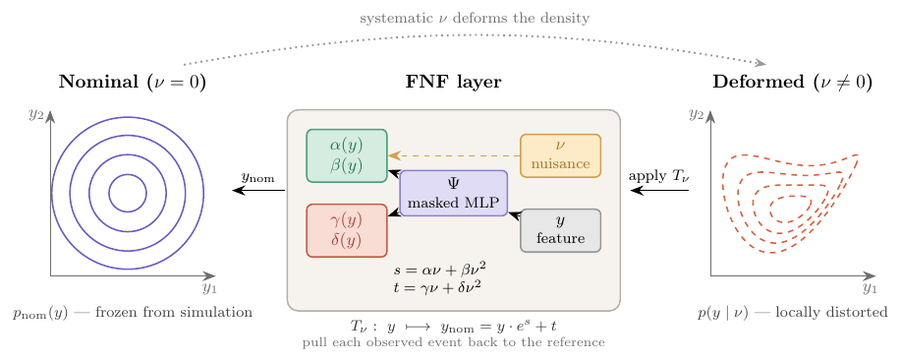
Normalizing flows model one fixed density, but inference in physics needs to know how a density deforms as a function of continuous parameters (calibration constants, systematic uncertainties). Learning one flow per parameter configuration does not scale, because the joint space grows exponentially. A Factorizable Normalizing Flow composes a frozen, high-fidelity flow for the nominal configuration with a learnable transformation that is polynomial in the parameters and factorized over them. Each parameter's effect is learned in isolation from samples where only that parameter is varied, and the joint response is recovered by summation at inference. This generalizes the classic "up/down template" morphing of HEP fits to a continuous, high-dimensional, differentiable setting whose cost scales linearly with the number of nuisances, with optional cross-terms for correlated effects. On a controlled problem the learned transformation reproduces the injected deformations and matches the optimal likelihood.
Profiling systematic uncertainties in Simulation-Based Inference with Factorizable Normalizing Flows Preprint
D. Valsecchi, M. Donegà, R. Wallny — arXiv:2602.13184 [hep-ph] (2026) · code
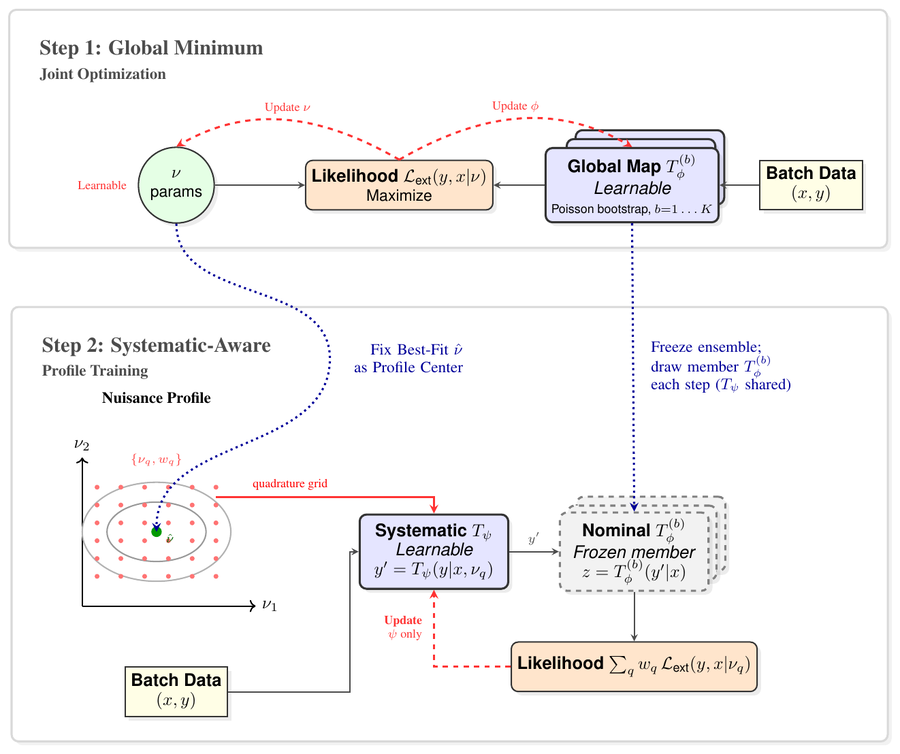
Unbinned likelihood fits extract the most information from data, but profiling systematic uncertainties in high dimensions has been computationally prohibitive, and most ML-based inference only measures scalar parameters. This work elevates the fit target to a Distribution of Interest (DoI), a learnable invertible map of the feature space, so that the measurement is a full distribution rather than a few numbers. Systematics are modelled with Factorizable Normalizing Flows, and an amortized training learns the dependence of the best-fit DoI on the nuisance parameters in a single optimization, replacing the repeated fits of a profile scan. A Poisson-bootstrap ensemble with an averaged likelihood propagates the finite-sample statistical uncertainty of the network itself. Validated on a synthetic HEP-like measurement, the framework aims to unify detector calibration, differential cross sections, unfolding and parameter estimation as one functional measurement.
From bins to flows: unbinned and multivariate scale factors CMS note
D. Valsecchi on behalf of the CMS Collaboration — CMS Performance Note CMS-DP-2025-053, presented at ACAT 2025 (2025)
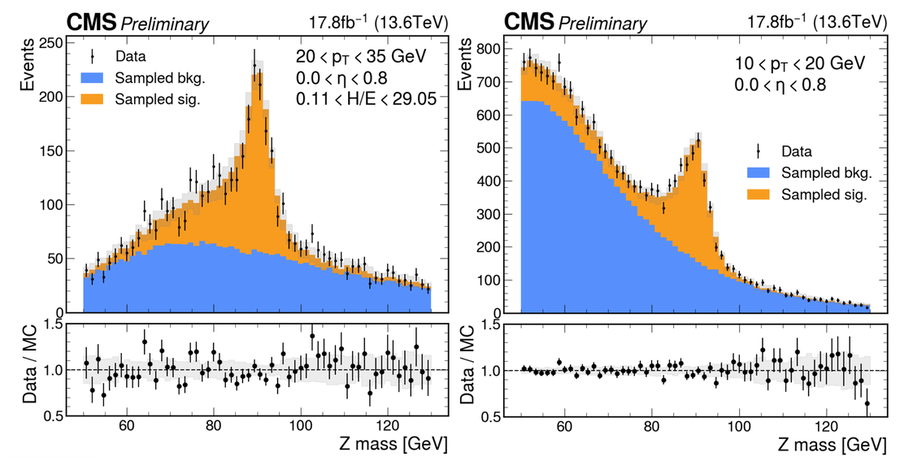
Most CMS objects and triggers are calibrated with Tag-and-Probe likelihood fits of the Z→ℓℓ mass peak, repeated in bins of pT and η. Adding more observables to the correction makes the number of bins, and the fitting time, explode. This note introduces an unbinned strategy in which probabilistic ML models (normalizing flows) perform the likelihood fit with several observables at once, producing multivariate, continuous efficiency scale factors for electrons and photons with better precision than the binned approach. It is the first CMS-wide application of the unbinned calibration programme.
MEMFlow: Computing the Matrix Element Method with generative machine learning CMS note
D. Valsecchi on behalf of the CMS Collaboration — CMS Performance Note CMS-DP-2025-046, presented at EuCAIF 2025 (2025)
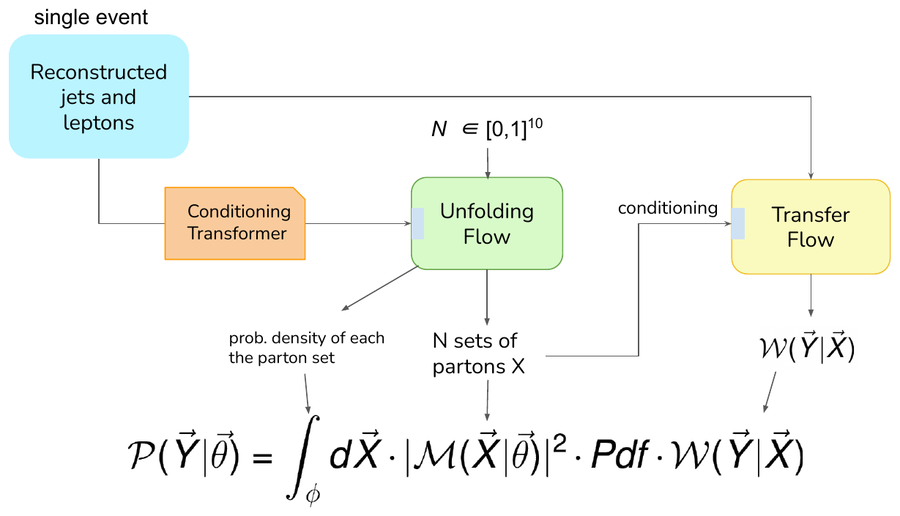
The Matrix Element Method (MEM) gives the statistically optimal per-event likelihood for a physics hypothesis, but requires expensive multi-dimensional integrals over the parton-level phase space convolved with detector transfer functions. MEMFlow replaces the classical integrator with transformers and generative models: ML surrogates sample the phase space of each process and encode the detector transfer functions, and the samples are used for neural importance sampling. The method is demonstrated on the challenging ttH(bb) semileptonic final state with the full CMS detector simulation, opening the way to unbinned likelihood fits of SMEFT couplings directly on data.
One Flow to Correct Them all: Improving Simulations in High-Energy Physics with a Single Normalising Flow and a Switch Journal
C. C. Daumann, M. Donegà, J. Erdmann, M. Galli, J. L. Späh, D. Valsecchi — Comput. Softw. Big Sci. 8, 15 (2024) · arXiv
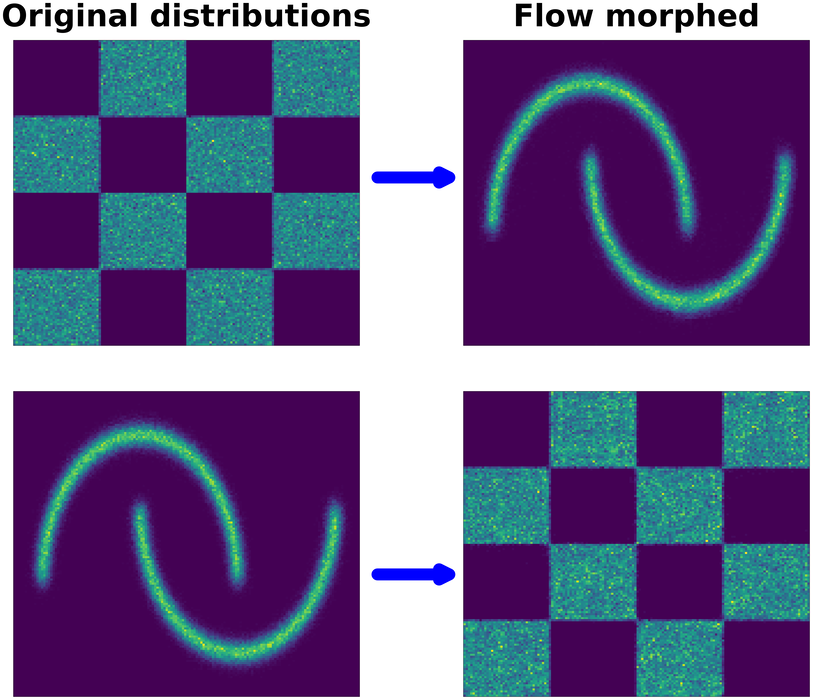
Simulation never matches data perfectly, and the differences in the shapes and correlations of the reconstructed observables must be corrected. This paper proposes a morphing method based on a single autoregressive normalizing flow conditioned on a boolean "IsData" switch: the flow is trained jointly on simulation and data to map both to a common base distribution, and simulated events are corrected by mapping them to the base space, flipping the switch, and mapping back. One flow with shared parameters replaces the chains of flows or pairs of networks used in earlier approaches. On a physics-inspired toy dataset with seven correlated variables and conditional mismodelling, the corrected simulation agrees with data at the percent level in the bulk and in the tails, and a BDT can no longer separate the two.
Performance of heavy-flavour jet identification in Lorentz-boosted topologies in proton-proton collisions at √s = 13 TeV Journal
CMS Collaboration — JINST 20 (2025) P11006 (2025) · arXiv
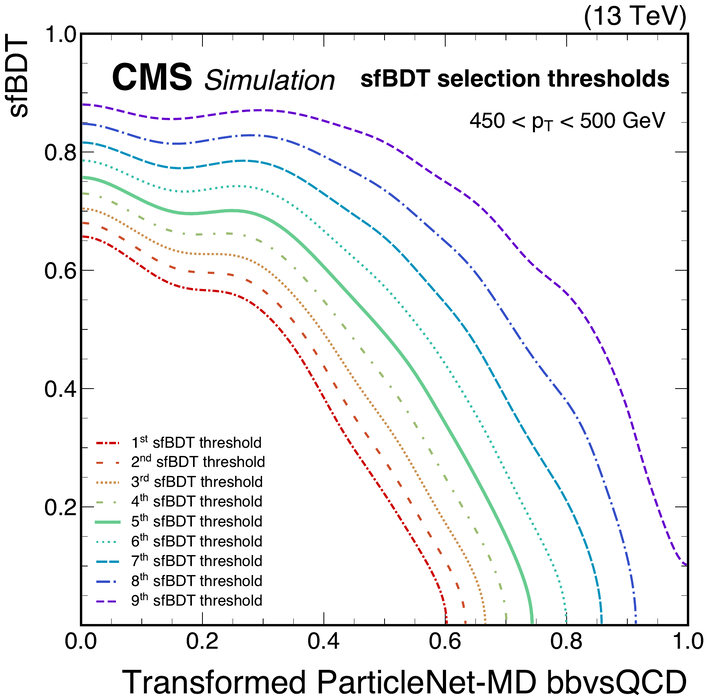
Boosted H→bb/cc and BSM searches rely on large-radius jet taggers that identify hadronic decays of massive particles. This paper documents the performance of the CMS boosted-object taggers on simulation and, above all, the novel calibration techniques on 2016–2018 collision data: three complementary methods in multijet events, based on machine learning, on muons inside energetic boosted jets, and on hadronically decaying high-energy Z bosons, are combined into a single set of scale factors. I developed calibration strategies for these taggers, which are now used across CMS physics analyses.
Deep learning techniques for energy clustering in the CMS ECAL Proceedings
D. Valsecchi on behalf of the CMS Collaboration — J. Phys. Conf. Ser. 2438 012077 (ACAT 2021) (2022) · arXiv
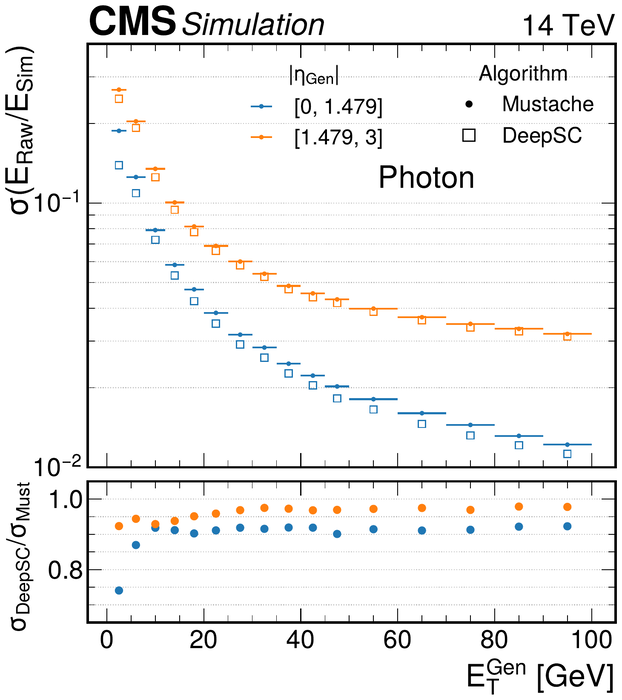
Electrons and photons spread their energy over several ECAL clusters because of bremsstrahlung and conversions in the tracker material bent by the 3.8 T field. The legacy "Mustache" superclustering algorithm groups clusters with a purely geometrical window and cannot reject pile-up or noise. DeepSC is the first ML superclustering for CMS: clusters are encoded with a GNN over their crystals, a dynamic graph is built with self-attention, and a graph-convolution plus attention stack decides which clusters belong to the seed, together with an energy regression and a particle-type output. It keeps the Mustache signal efficiency while removing most pile-up and noise contamination, improving the uncorrected energy resolution mainly at low energy and high |η|, and flattening the dependence on pile-up. Follow-ups: IEEE NSS-MIC 2022 proceedings and the CHEP 2024 paper on deployment in the CMS reconstruction.
Evidence for WW/WZ vector boson scattering in the decay channel ℓνqq produced in association with two jets in proton-proton collisions at √s = 13 TeV Journal
CMS Collaboration — Phys. Lett. B 834 (2022) 137438 (2022) · arXiv
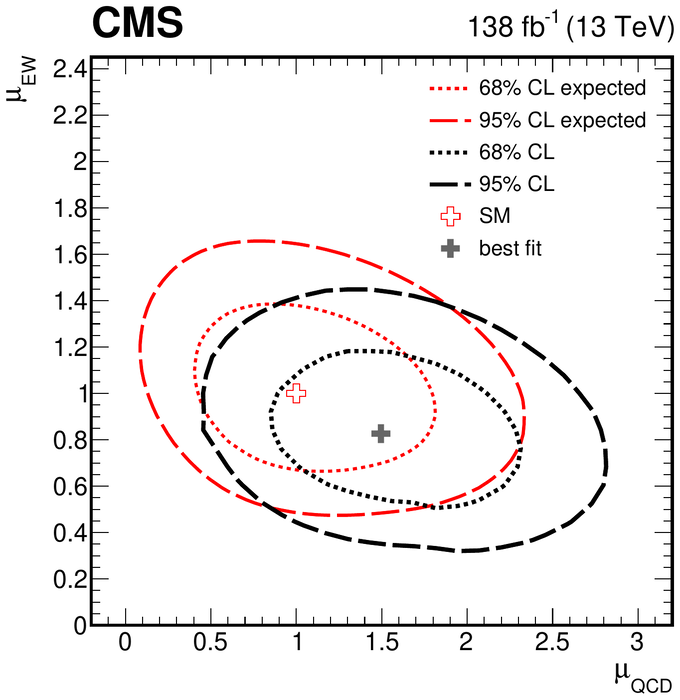
Main result of my PhD thesis. Vector boson scattering probes electroweak symmetry breaking directly, and the semileptonic channel has the largest branching ratio but an overwhelming W+jets background. Using the full Run 2 dataset (138 fb⁻¹), events with one lepton, two forward jets and a hadronic W/Z candidate (resolved or as one large-radius jet) are classified with DNN discriminators, and the dominant backgrounds are constrained in dedicated control regions with a data-driven strategy. The electroweak WV signal strength is 0.85 ± 0.12 (stat) +0.19/−0.17 (syst), a significance of 4.4σ (5.1σ expected): the first evidence of VBS in the ℓνqq final state at the LHC.
Comparing quantum and classical machine learning for Vector Boson Scattering background reduction at the Large Hadron Collider Journal
D. Cugini, D. Gerace, P. Govoni, A. Perego, D. Valsecchi — Quantum Machine Intelligence 5, 35 (2023)
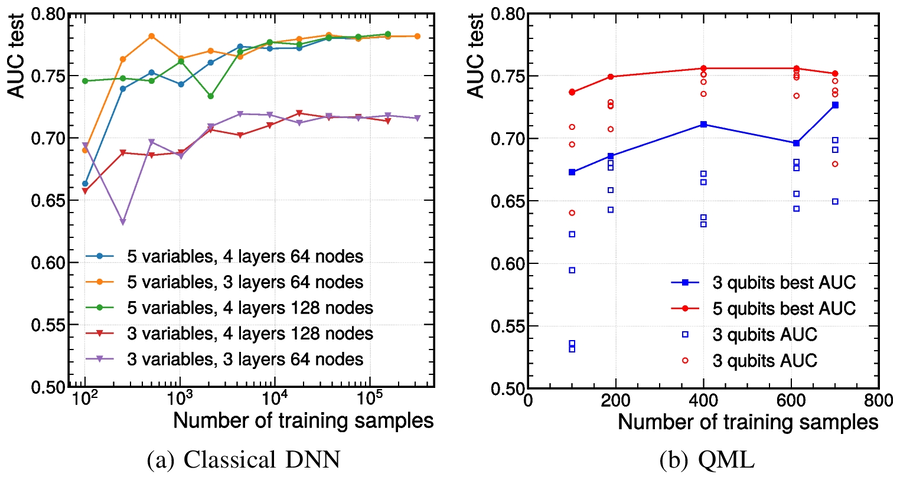
A controlled comparison between variational quantum circuits, run on publicly available quantum hardware, and classical deep neural networks for separating VBS signal from background at the LHC. The quantum classifiers reach an AUC very close to the classical networks while using far fewer parameters and less training data, one of the first proof-of-principle studies of near-term quantum hardware for event classification in HEP.
Other publications
-
Optimizing electron and photon reconstruction using deep learning: application to the CMS electromagnetic calorimeter Proceedings
D. Valsecchi on behalf of the CMS Collaboration — J. Phys. Conf. Ser. 3206 012102 (CHEP 2024) (2026) -
Deep Learning Techniques for Energy Clustering in the CMS Electromagnetic Calorimeter Proceedings
B. Marzocchi, D. Valsecchi on behalf of the CMS Collaboration — 2022 IEEE NSS-MIC-RTSD conference proceedings (2022) -
Search for vector boson scattering with the semi-leptonic WV signature at CMS Proceedings
D. Valsecchi on behalf of the CMS Collaboration — PoS EPS-HEP2021 441 (2022) -
First evidence of VBS in semileptonic decays with WVjj → ℓνqqjj final state and optimization of the CMS electromagnetic calorimeter for Run III Thesis
D. Valsecchi — PhD thesis, Università degli Studi di Milano-Bicocca (2022) -
ECAL trigger performance in Run 2 and improvements for Run 3 Proceedings
D. Valsecchi on behalf of the CMS Collaboration — JINST 15 C06037 (2020) -
Optimising the performance of the CMS Electromagnetic Calorimeter to measure Higgs properties during Phase I and Phase II of the LHC Proceedings
D. Valsecchi on behalf of the CMS Collaboration — PoS EPS-HEP2019 161 (2020)
Software
- PocketCoffea — creator and lead developer. Configuration-driven columnar analysis framework for CMS NanoAOD on Coffea/Awkward/Dask; about 20 active contributors, about 20 public analyses and calibration tools on GitHub built on it. Docs · PyPI · PyHEP 2023 talk.
- factorizable-normalizing-flow — reference implementation of Factorizable Normalizing Flows (Zenodo).
- distribution-of-interest-profiling — code for the amortized profiling of systematics in unbinned fits (Zenodo).
- Zuko — contributor. Normalizing flows in PyTorch.